Neighbouring the United States: A Glimpse of how it feels like.
In the very beginning I decided not to argue about internal politics in my blog, and this entry is NOT about U.S. relations with my country but more of my views in how I feel in what respects to living in one of the United States' neighbouring countries. I decided to write about this because many people around the world have a very false and most of the times unreal stereotype of the United States.
I do not call it 'America' because that is the name of a continent, I am American as somebody from Colombia, Guatemala, Cuba, Argentina, Guyana, Suriname, Canada or any other country found in the continent. I call the inhabitants of the United States of America 'U.S. Citizens'. This clarification is part of my idea to get rid of stereotypes, because if somebody talks about 'Americans', it would seem that the rest of us from other countries inside America are excluded. I am not intending however, to convince everybody about this. In the same tone as I wrote in my post about Syria, I do not intend to convince nor to claim my words as the absolute truth.
It is true that the United States has been criticised a lot during the XX century, I believe that in spite of the clashes my country has had with them since they became independent, they have good things too. The United States is a unique country. To begin with, they started from fifteen colonies and transformed itself into the giant colossus we know today. The Founding Father's principles are still present in almost every single cultural, political and social process given in the country.
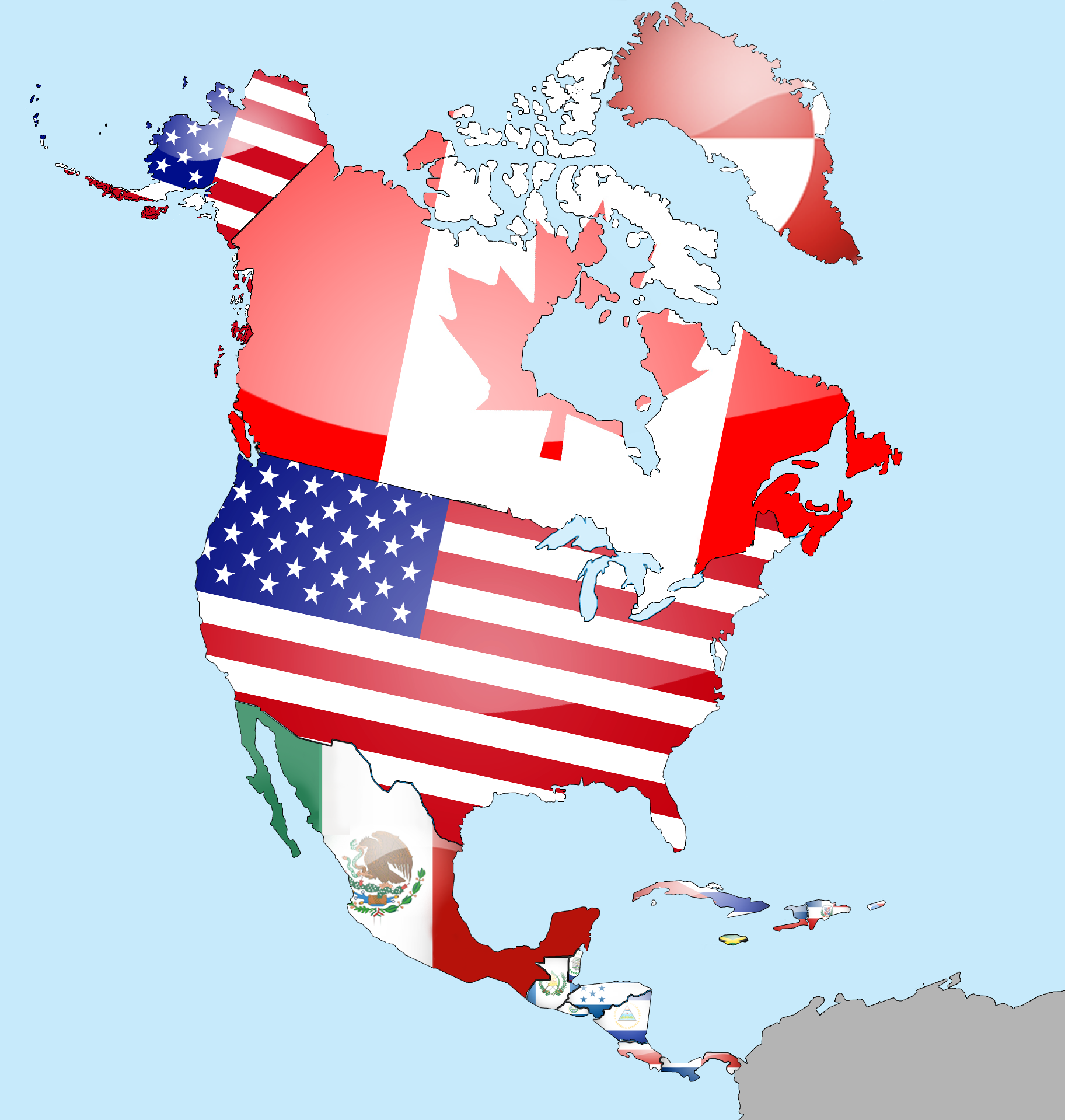
I would say that for the three of us (Canada, Mexico and the U.S. itself) it is really hard trying to manage relations among us and with each other. North America is complex on all senses because, to begin with, Canada and the U.S. are similar in the language and are equal in other things such as historical legacy Mexico, on the other hand, has a totally different language and a historical legacy that has allowed it to achieve great accomplishments but, being stuck at the same time.
In my view, the best example of how different and complex we are is the disastrous results brought by the NAFTA, mostly for Mexico due to economic and social asymmetry. Canada, on the other hand, has much more resources (mostly economic) that allow them to be more coercitive in negotiations. In spite of all these differences, economic and trade relations are carried out quite smoothly in North America. Mexico has had many problems trying to tranform its institutions and laws under the name of neoliberalism. This has caused more damage than benefit to the country, for we have very few national industries left and many things we used to produce are now imported (like corn). It is true what many analysts have said: thanks to the policies derived from NAFTA's implementation, the balance has been more negative than positive and this has been worsened by internal clashes in both private and public sectors.
We cannot be on the level of neither Canada nor the United States in the quick pace some administrations have intended to achieve, it is impossible. Neighbouring a developed country has its disadvantages: sometimes on the name of progress, governments end up damaging their countries rather than benefiting them, this is pretty much why an economic collapse in the United States damages us more than a collapse elsewhere. The United States has of the most important voices in what respects to economic and trade affairs inside Mexico. Anyhow, many Mexican products are well positioned in the United States, and this is an advantage derived from our geographical position.
It is also true that it is very difficult for Mexico to manage relations smoothly with the United States once in a while. There are very few Mexicans aware of history and this makes us to trip over the same stone many times in a row and, to be honest it is not easy to deal with the United States in foreign policy matters. In my opinion, the hardest things we have faced with them are the partition of Mexico derived from the Guadalupe-Hidalgo Treaty of 1848, the years of the Mexican Revolution and, the Cold War years.
In what respects to the partition, the means by which the United States took possesion of Texas by sending their nationals is questionable and was also used in a different way in Central America with dictators like Ubico and the Somoza. I cannot understand the annoyance of some U.S.citizens when they find so many people with a Mexican surname on the Southern United States. Well, before 1848 they had Mexicans there (very few, though...this is why we lost it so easily, apart from other mistakes committed by us. Who knows what would have happened if Polk had decided for the 'All Mexico' Policy). Actually, the second city with more Mexicans apart from Mexico City is Los Angeles in California. This is a deep wound in some sectors of the country but, very few are aware of the implications this had for us.
The period of the Mexican Revolution meant for both countries digging ourselves in our own problems. The United States had a remarkable growth while Europe was destroying itself with WWI, as for us, the Revolution created the base for the problems that would condemn us for the rest of our lives and our national fate. It is said that Francisco Villa passed the border and, that if it weren't for the First World War, we would have had another invasion.
The Cold War meant a big deal for Mexico because we also had our own Communist infiltrations and also due to our geographical condition with our Central American brothers. The premise of the U.S. having no friends, just interests started to be noticeable on that time of the Cold War, not only in America but everywhere: Korea, Vietnam and Europe. In South America there are still many people who are skeptic about the death of Salvador Allende and the legitimacy of people like Augusto Pinochet. Anyhow the U.S. had a tough loss with Vietnam and with Korea, totally OPPOSITE to what Koreans believe (their acceptance of U.S. presence is astonishing for many of us), they just want their presence in Asia to prevail and, the help during the war was not a matter of altruism but of interest (moreover with China and Mao up there).
Unfortunately, many people in Europe and in Korea believe that they help them because of altruism...something very far from reality, and this last thing can be proved by the reluctance from many people who are firmly opposed to their presence inside the Middle East. The other part of the puzzle is the famous ALBA movement in Latin America (which I disagree with, for I do not like the ways in which some of those governments claim legitimacy by lying to their people) and also the increasing opposition the United States is facing in the UN and in the Security Council with both China and Russia.
It would be a lie to say that all U.S. citizens are the same, because they are not. I would say that the U.S. society is not like their government (or that the whole government is like their foreign policy), many people there are not aware of what happens to the outside and are not aware of how foreign policy tools are used. Wright Mills inside his analysis of the Elite Theory, shows that power and more improtantly, DECISIONS in the United States are on the hands of really few people. If what members of the Tea Party or other extreme groups say was true, then all the U.S. would hate immigrants (this is an irony, for many U.S. citizens are of foreign origin and diversity is one of the elements that make the United States strong) and they would also support all the warfare being done in the Middle East. This premise is false, many U.S. people are thankful for the presence of my people, who are hardworking and do constitute a relevant part inside productive migration (which makes it different from the one in many places in Europe).
There are also U.S. citizens who believe that intervention in the Middle East is a mistake and that it should stop because it is generating unnecessary hate towards their country elsewhere. I have met many valuable people from both the government and civil population. Personally, I regard in a very positive way some of the efforts being done to stop or at least decrease violence given in the border with Mexico. This is an example of my premise about valuable people inside the United States, because cooperation will ALWAYS need two sides, moreover when the issue is affecting both countries negatively. Unfortunately, this is a bilateral issue and, Europe should also be aware of this for their consumer population is also alarming. I wll not discuss this further.
I hope that this glimpse gives my readers some idea of how complex, hard and pragmatic realtions with the United States are and can be for one of the neighbours and therefore stop idealising or insulting the United States of America. Some of us try to look at it with philosphy: They will ALWAYS BE THERE on the other side of the border, so, let's try to be smart friends instead of enemies.

I do not call it 'America' because that is the name of a continent, I am American as somebody from Colombia, Guatemala, Cuba, Argentina, Guyana, Suriname, Canada or any other country found in the continent. I call the inhabitants of the United States of America 'U.S. Citizens'. This clarification is part of my idea to get rid of stereotypes, because if somebody talks about 'Americans', it would seem that the rest of us from other countries inside America are excluded. I am not intending however, to convince everybody about this. In the same tone as I wrote in my post about Syria, I do not intend to convince nor to claim my words as the absolute truth.
It is true that the United States has been criticised a lot during the XX century, I believe that in spite of the clashes my country has had with them since they became independent, they have good things too. The United States is a unique country. To begin with, they started from fifteen colonies and transformed itself into the giant colossus we know today. The Founding Father's principles are still present in almost every single cultural, political and social process given in the country.
I would say that for the three of us (Canada, Mexico and the U.S. itself) it is really hard trying to manage relations among us and with each other. North America is complex on all senses because, to begin with, Canada and the U.S. are similar in the language and are equal in other things such as historical legacy Mexico, on the other hand, has a totally different language and a historical legacy that has allowed it to achieve great accomplishments but, being stuck at the same time.
In my view, the best example of how different and complex we are is the disastrous results brought by the NAFTA, mostly for Mexico due to economic and social asymmetry. Canada, on the other hand, has much more resources (mostly economic) that allow them to be more coercitive in negotiations. In spite of all these differences, economic and trade relations are carried out quite smoothly in North America. Mexico has had many problems trying to tranform its institutions and laws under the name of neoliberalism. This has caused more damage than benefit to the country, for we have very few national industries left and many things we used to produce are now imported (like corn). It is true what many analysts have said: thanks to the policies derived from NAFTA's implementation, the balance has been more negative than positive and this has been worsened by internal clashes in both private and public sectors.
We cannot be on the level of neither Canada nor the United States in the quick pace some administrations have intended to achieve, it is impossible. Neighbouring a developed country has its disadvantages: sometimes on the name of progress, governments end up damaging their countries rather than benefiting them, this is pretty much why an economic collapse in the United States damages us more than a collapse elsewhere. The United States has of the most important voices in what respects to economic and trade affairs inside Mexico. Anyhow, many Mexican products are well positioned in the United States, and this is an advantage derived from our geographical position.
It is also true that it is very difficult for Mexico to manage relations smoothly with the United States once in a while. There are very few Mexicans aware of history and this makes us to trip over the same stone many times in a row and, to be honest it is not easy to deal with the United States in foreign policy matters. In my opinion, the hardest things we have faced with them are the partition of Mexico derived from the Guadalupe-Hidalgo Treaty of 1848, the years of the Mexican Revolution and, the Cold War years.
In what respects to the partition, the means by which the United States took possesion of Texas by sending their nationals is questionable and was also used in a different way in Central America with dictators like Ubico and the Somoza. I cannot understand the annoyance of some U.S.citizens when they find so many people with a Mexican surname on the Southern United States. Well, before 1848 they had Mexicans there (very few, though...this is why we lost it so easily, apart from other mistakes committed by us. Who knows what would have happened if Polk had decided for the 'All Mexico' Policy). Actually, the second city with more Mexicans apart from Mexico City is Los Angeles in California. This is a deep wound in some sectors of the country but, very few are aware of the implications this had for us.
The period of the Mexican Revolution meant for both countries digging ourselves in our own problems. The United States had a remarkable growth while Europe was destroying itself with WWI, as for us, the Revolution created the base for the problems that would condemn us for the rest of our lives and our national fate. It is said that Francisco Villa passed the border and, that if it weren't for the First World War, we would have had another invasion.
The Cold War meant a big deal for Mexico because we also had our own Communist infiltrations and also due to our geographical condition with our Central American brothers. The premise of the U.S. having no friends, just interests started to be noticeable on that time of the Cold War, not only in America but everywhere: Korea, Vietnam and Europe. In South America there are still many people who are skeptic about the death of Salvador Allende and the legitimacy of people like Augusto Pinochet. Anyhow the U.S. had a tough loss with Vietnam and with Korea, totally OPPOSITE to what Koreans believe (their acceptance of U.S. presence is astonishing for many of us), they just want their presence in Asia to prevail and, the help during the war was not a matter of altruism but of interest (moreover with China and Mao up there).
Unfortunately, many people in Europe and in Korea believe that they help them because of altruism...something very far from reality, and this last thing can be proved by the reluctance from many people who are firmly opposed to their presence inside the Middle East. The other part of the puzzle is the famous ALBA movement in Latin America (which I disagree with, for I do not like the ways in which some of those governments claim legitimacy by lying to their people) and also the increasing opposition the United States is facing in the UN and in the Security Council with both China and Russia.
It would be a lie to say that all U.S. citizens are the same, because they are not. I would say that the U.S. society is not like their government (or that the whole government is like their foreign policy), many people there are not aware of what happens to the outside and are not aware of how foreign policy tools are used. Wright Mills inside his analysis of the Elite Theory, shows that power and more improtantly, DECISIONS in the United States are on the hands of really few people. If what members of the Tea Party or other extreme groups say was true, then all the U.S. would hate immigrants (this is an irony, for many U.S. citizens are of foreign origin and diversity is one of the elements that make the United States strong) and they would also support all the warfare being done in the Middle East. This premise is false, many U.S. people are thankful for the presence of my people, who are hardworking and do constitute a relevant part inside productive migration (which makes it different from the one in many places in Europe).
There are also U.S. citizens who believe that intervention in the Middle East is a mistake and that it should stop because it is generating unnecessary hate towards their country elsewhere. I have met many valuable people from both the government and civil population. Personally, I regard in a very positive way some of the efforts being done to stop or at least decrease violence given in the border with Mexico. This is an example of my premise about valuable people inside the United States, because cooperation will ALWAYS need two sides, moreover when the issue is affecting both countries negatively. Unfortunately, this is a bilateral issue and, Europe should also be aware of this for their consumer population is also alarming. I wll not discuss this further.
I hope that this glimpse gives my readers some idea of how complex, hard and pragmatic realtions with the United States are and can be for one of the neighbours and therefore stop idealising or insulting the United States of America. Some of us try to look at it with philosphy: They will ALWAYS BE THERE on the other side of the border, so, let's try to be smart friends instead of enemies.


Comentarios
Publicar un comentario