The Role of Discourse in Straining Japan-Korea Relations.
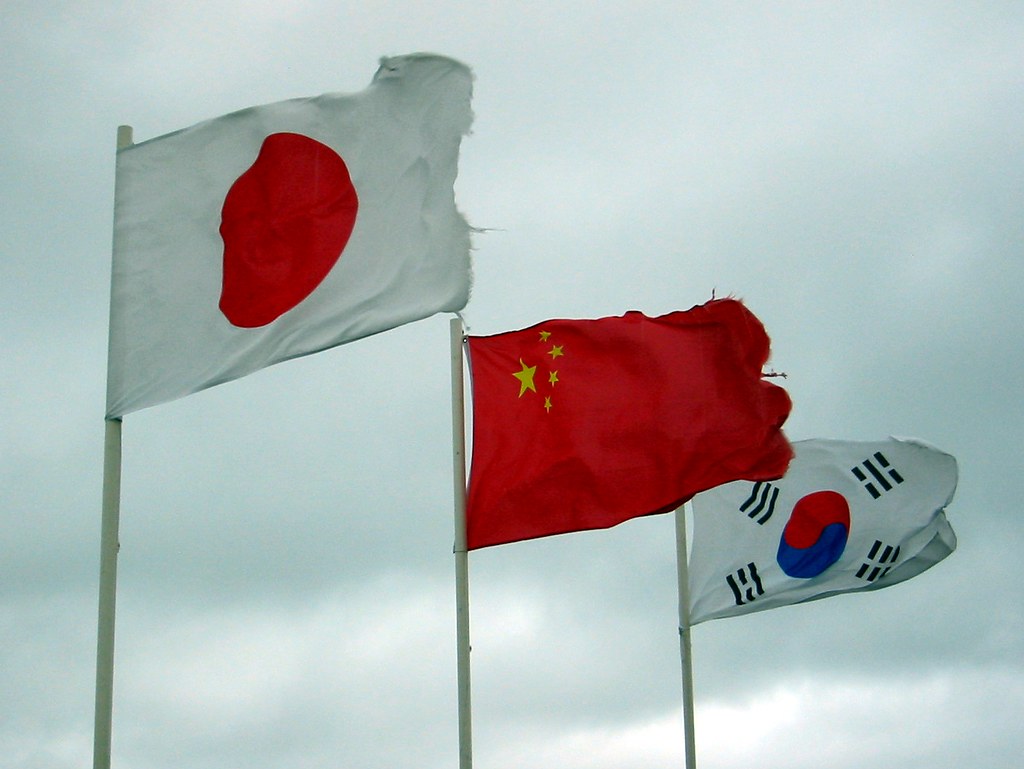
Japan and Korea have been facing ups and and downs in their interactions since the end of World War II. The role of Japan on this matter, has served as a determinant factor within the context of foreign affairs in Asia, for it affects interests and relations among the most important economies on the continent, namely Japan, Korea and China.
The past is revived almost every year at the moment Korea celebrates its National Liberation Day and whenever Japanese officials visit Yatsukuni Shrine. The way foreign affairs and everything related to them therefore, depend on how each of the parties and their governments interpret and react towards how history has been told.
China's economic and political power in the region is also a determinant factor within the whole context of international relations and, in the particular case of Korea and Japan, China serves as a decision factor for the other two countries to go one way or look for alternatives. Korea, either South or North, have inclined towards economic and cultural affinity with China in spite of the strong presence of the United States in South Korea.
Japanese imperial ambitions based on a strong concept of nationalism achieved its highest point during the Meiji Period and translated into a myriad of cruel acts and invasions all over Asia.The extent on which Japan damaged the continent is still present in most, if not all, countries. Some have moved forward (but still emphasise the importance of historical memory), while others are still using Japan's past as an axis to design a part of their foreign policy and also, as a pivot for their discourse regarding conflict management (Korea obeys to these criteria), and even as a justification for legitimising their means and their ends, (like in the case of China).
Japan did not leave the whole aftermath of the war without any kind of issues or damages. The country was devastated on all matters, but the biggest post-war issue Japan faced was the loss of the much valued honour. Japan did not lost the war at the moment of surrender or at the moment Hiroshima and Nagazaki were destroyed. Japan lost the war at the moment the country was torn from the inside through humiliation and foreign occupation.
Recovery was hard and painful, not only for Japan, because Korea suffered another terrible war just a little more than five years afterwards. The long struggle of the Cold War also served as an important factor for Asian countries to choose a side, and it also served as the pivotal stage for division in the Korean Peninsula.
After the end of the Korean War, South Korea faced many hardships to build itself, in between destruction and hunger, the country achieved remarkable progress around the end of the Cold War, whereas North Korea's progress got hindered, and all support received by the Kim regime disappeared in a matter of years. Nowadays Korea is an important actor on the continent both on economic and strategic terms.
Division and the acceptance of it as a natural condition within the Peninsula, has determined a stark division of enemies and allies. China has its interests on the North by supporting the Kim regime and not allowing the United States get close to the 38th Parallel. The United States has its reasons to be in South Korea and to set military bases around the continent.
Korea therefore takes for granted that the only problem they have is Japan, because eventhough the way Chinese influence and occupation are highly contested issues, both Koreas still regard Japan as an uncomfortable neighbour, and in the case of North Korea, Japan is still regarded as an enemy.
Apart from the United States, Japan is one of the most relevant reasons for North Korea to remain as a garrison state. In the South, Japan still has a negative perception and in both cases, governments have a share of responsibility in shaping perceptions of Japan in this way.
Korea, since the beginning of its consolidation as a nation-state, has been trying to shape an identity that goes beyond the legacy of China and Japan. Culturally, Korea has adopted many distinctive traits from the neighbours, such as the Lunar Year, or festivities like the White Day. Koreans have also adopted a strong sense of honour and a zero tolerance towards failure, as well as a strong appreciation for family values and honesty.
This affinity would bring a positive interpretation regarding relations between Japan and Korea, but the war legacy is of the principal obstacles to carry out successful relations. This war legacy is focused mainly on two issues: territorial and geographical disputes (Dokdo-Takeshima, East Sea-Sea of Japan) and wartime slavery.
The issue of Dokdo-Takeshima Islands has its origins in the confusion left by World War II agreements, were territorial division was not precise. One of the main sources, the Japanese Peace Treaty, was supposed to state that Takeshima Islands were given to Korea, but in the end, such statement was not written in the treaty.
There are also some sources, mainly maps and documents, that put the islands as part of Korea. Japan claims otherwise, by explaining through documents of the XVII century that Dokdo-Takeshima were always part of their territory. Japan claims constant violations to their sovereignty on these islands through events such as Korea's presence in the 1950s during President Park's mandate (father of Mrs. Park, the current President of the Republic of Korea), when Korean vessels were sent to islands and therefore, 'illegally' occupied.
Currently, the Korean government has assumed the role of convincing the Korean people (and up to some extent, foreigners) regarding Dokdo-Takeshima as part of Korea, through commercials, advertisements and small-scale models spread throughout the city in subway stations. Japan has also assumed a similar role, by celebrating Takeshima Day, and also by spreading information through media. The issue is still on the way to be solved through the International Court of Justice. It is important to emphasise that in spite of the constant North-South clashes, Pyongyang is supportive regarding this issue with Seoul.
There is a similar clash of ideas regarding the Sea of Japan and the East Sea, where Korea claims that East Sea is a confusing term and, that in the end, the sea is just another part of the Pacific Ocean. According to Korea, there are maps of the XIX century which have the 'East Sea' legend. In spite of these claims, most sources around the world still use 'Sea of Japan'.
These matters continue to have a strong priority inside Korea's foreign policy agenda, nevertheless the issue of wartime slavery keeps on being the main clash between Japan and Korea. The fact of atrocities committed during the war is undeniable, and the kidnapping of Korean women is an evident crime that went against all laws regarding war.
Japan in general terms has not denied anything regarding the issue, but on one hand, sources in Korea convey that the Abe administration has been keen towards reinventing history on the matter. Japan, on the other, states that apologies are a must and that it will never be possible to compensate damages. The whole issue can be analysed from the historical point of view, where the importance of past experiences is a priority in order to avoid making the same mistakes, and Japan therefore should keep its peaceful tradition by not forgetting the past as it is.
Japan has tougher challenges to cope with, however. Prime Minister Shinzo Abe is having a difficult time due to the economic problems within the country. The policy package of 'Abenomics' is not showing many signs of recovery, something that has generated criticisms towards the government.
Crisis is not exclusive to Japan, because Korea is also facing a tough challenge with unemployment and the rise of prices. Since both countries have a dependence on imports regarding commodities, economic policies are a common challenge. In this regard, China is also a challenge not only for these two countries, but for the whole region in general. The low costs of production and labour, among others, constitute a threat on the short term for any economy, particularly in the case of Korea, where local consumption and production are strong.
Foreign policy is an important tool to achieve strategic alliances and cooperation, and accurate decisions are required in order to make it work in favour of the national interest. Japan and Korea will always be neighbours, and at the same time, these two will always be China's neighbours as well. Therefore, since anarchy keeps on being the current condition on the international system making in increasingly unpredictable, nations and policy makers have to concentrate on new policy-making levels.
Strategic alliances are a necessary resource if countries are to be successful in facing challenges. Discourse is a very important tool at the moment of designing policy and making decisions. Japan and Korea could focus more on common objectives and do not allow their differences to keep on prevailing in their interactions, because this could also serve for other parties to have a not necessarily positive advantage that could be used against them.
 |
| (c) Image from Flickr |
 |
| (c) Voice of America |
 |
| President Park Geun Hye and Prime Minister Shinzo Abe (c) Asahi |
 |
| President Park Geun Hye, President Xi Jinping and Prime Minister Shinzo Abe (c) Korea Herald |


Comentarios
Publicar un comentario