U.S-Cuba Relations: A New Paradigm for Latin America?
This Summit of the Americas held in Panama City
has been different to the rest in many ways. In spite of me not being a
specialist in Latin American affairs and/or North America affairs or U.S.-Latin
America relations, as a Latin American and a citizen from the U.S. immediate
neighbouring country, I decided to write something about what we are witnessing
now in the Summit. I hope this entry is informative for my non-Latin American
and non-North America readers.
Since I studied my Master's degree in the
United Kingdom, I witnessed many arguments that were biased and non-congruent
in many ways (not to say unrealistic) regarding the situation being held on
this side of the world. The first thing that Europeans and any other peoples
who live thousands of kilometers away from us is that one of the biggest
challenges faced by Latin America in general, and Mexico in particular, has
been the eternal presence and influence of the United States both in regional
and internal affairs.
The strongest arguments and critiques I have
encountered towards the role of the United States on the international arena,
mainly come from either academics or people from the Middle East. In many ways
they are accurate, while in some others they are wrong to claim that this
behaviour they have been witnessing is
in general and that what they see is what ‘should be happening’ elsewhere,
including Latin America.
In this regard, the role of the United States
in Latin America has been intrusive both in the strict sense of military
intervention and also in figurative language, where they have been present in
all decision making processes within the high spheres of policy making in many
countries, but mainly in Central America, Cuba and of course, in Mexico. The
case of U.S. support towards military regimes in Chile for example, is also
real as well as CIA intervention in political affairs.
It is of
the upmost importance however, to say that in all cases, people from the
country and most particularly, local politicians or local elites have been
involved in making U.S. intervention easier in local affairs, whereas in the
Middle East, in many cases invasion came as step one. Nevertheless, this is very different from
saying that the United States is 100% responsible of whatever happens to us in
this region.
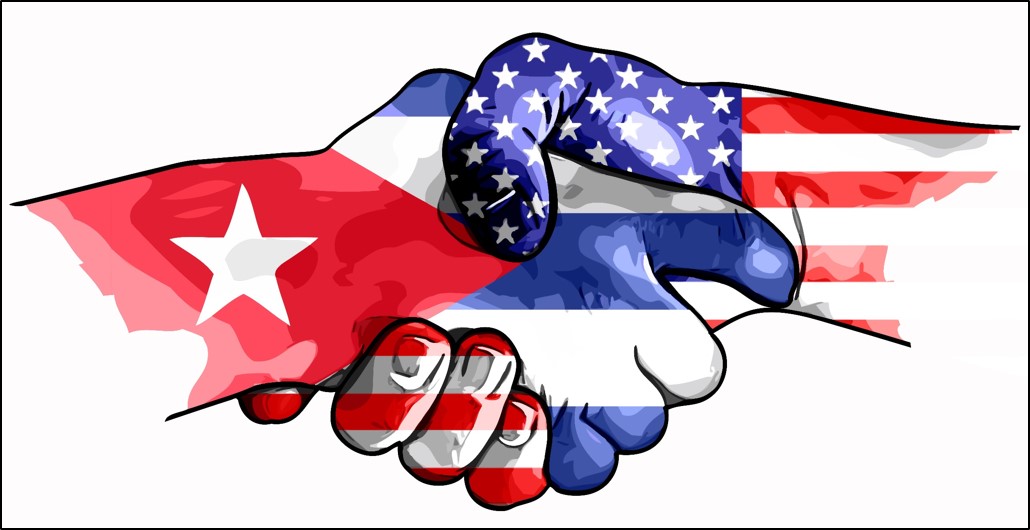
The issue of the Cuba embargo represents a low
kick against American pride, because the Castro regime has been able to survive
since the 1950s and has been able to overcome all the invasions perpetrated by
the marines (with its negative consequences for the Cuban people of course).
The United States, whether we like it or not, has been able to exploit one of the
biggest defects prevalent in all Latin American countries except for Chile and
Uruguay: corruption. This is only half of the reasons why the United States has
been having a limited success regarding intervention in local affairs of Latin
American countries.
The cultural part translated into internal
division, social struggles and conflict, and most importantly, the wide gap between
rich and poor explain quite a lot regarding this success: As long as there is a person or a group of
people inside the country making things easier for the interested party,
intervention has more chances to be successful. This explains pretty much why
in Cuba you find two kinds of people: those who support the Castro regime and
stayed there, and those who fled the country and try to discredit the regime
from the outside. Some can claim that it is the same situation with Venezuela,
but on this matter, suffering is more of an imposed condition derived of bad
decisions rather than a matter of the system itself, because in the end, Hugo
Chávez and Nicolás Maduro are there because up to some extent, people chose
them.
Personally, I have very serious doubts
regarding the whole discourse and tales of ‘Revolution’ and of ‘Social Struggle’
prevalent in Venezuela, where people are under starvation, economy is plummeting,
violence is worse than in my home country (Is this EVEN possible?), and where
people are given money without working. These are very serious matters which
white opposite to the idea of creating ‘social equality’, it is creating a
parasitic system where the benefits generated by a minority and enjoyed by a
majority that finds much better to be in the ‘no work but I get money’ comfort zone. Ironically, those who claim that the United
States is responsible of every single problem held in the region, are the ones
who have the biggest indexes of corruption. It is not new for this region the
fact of millionaire underwater oil agreements between the United States and
Venezuela as the main rule of economic relations between the two countries.
In this regard, the discourse of President Obama
during the summit did show interesting ideas, because he claimed that the new
position towards Cuba is a proof of commitment for a change in the way the
United States now seeks to carry its foreign policy. Something worth paying
attention to, is what he explained regarding contradictions within actions and
discourses of human rights, where he highlighted the importance of democracy
and most particularly, freedom of speech.
President Obama also did something quite
uncommon in U.S. politicians: he
portrayed the United States as a country with problems and faults (he spoke
about security, arms trafficking, economy, etc.), something that somehow contradicts
the ‘City upon a Hill’ and Manifest Destiny doctrines. It is a very good sign
to see that the United States might start to have some self-criticism. In my
view, this along with the stance he took regarding security and how drugs are damaging
both neighbouring countries and the U.S. itself, might have led to the positive
response coming from Raul Castro.
Latin America can be hopeful for the future,
because (unless Republicans get into power and do not get rid of Tea-Party-ish
ideas) there seems to be start for a change in their attitude. The U.S. should
be aware of the fact that geography is a permanent condition, and that being in
good terms with the neighbours is the best way forward on the long term. The
United States should consider all the available assets found in the region such
as a productive workforce and valuable resources.
The biggest challenge in terms of security
reduces itself to one question: Who will end up imploding? The U.S. is under a
very critical social crisis, where apart from the economic issue, there is a
very severe problem regarding how average Americans view and live their lives.
In spite of being a rich country, people seem to be unhappy, which can pretty
much explain why drug consumption and violence (e.g. school shootings) are such
big problems. Giving the necessary means for people to kill each other might be
a good business, but it is not good for society in general (even less for the
world).
Latin American countries should exercise a more
responsible policy-making process and be able to defend local interests and seek peoples' well-being,
because the adoption of neoliberalism has caused nothing except the widening of
the rich-poor gap. We cannot expect to turn our national economies into
something of the size of the U.S. or Canada or Europe just during the overnight.
Governments should also stop formulating macroeconomic policies that imply a
high social cost, because in the end having a strong middle class is one of the
keys for a successful economy, as well as giving the adequate conditions for
economic activity to be carried out successfully. Low salaries and expensive
resources will only lead to the stagnation of economic activity with a huge
inflation rate. Lastly, we should also be more critical with ourselves and stop
blaming everybody (including the U.S.) except ourselves and our attitudes and
actions for whatever happens with our countries.
 |
| (c) Summit of the Americas |
 |
| (c) Havok Journal |


Comentarios
Publicar un comentario