Mexico: The Country of Hidden Secrets
I explicitly forbade myself
to write about my own country in my blog because I wanted to make this only
about international relations and not turn it into a mess in which debates
would be held under my writings. This time however, a very good friend of mine
encouraged me to write about my country in the sense of culture and traditions
we have. There are many people out there who have a very blurry and even
mistaken image from Mexico, and since our internal politics have not been
precisely successful since 1994, our image has been worsening a lot since then.
Thanks to the tough situation we (me and my nationals) have been living since
2006, it is very hard for outsiders to conceive Mexico in a positive way. This
post is not about these problems, nor is about internal politics, which I just
hate to argue about. The post is mainly directed to foreigners however, my
fellow nationals might find it interesting in the sense of finding some
positive things about our country in spite of the situation we are living in.
Mexico is a country located
between the United States to the north and Belize and Guatemala to the south. Mexico comes from the other name given to Aztecs, they were also known as 'Mexicas', Spanish first wrote Mexicio with a j: Mejico. Today however, we do not recognise (neither like) to see Mexico written with a j, because we are not a Spanish colony anymore. Mexico City was founded in 1325 by the Aztecs, who were told by their god Huitzilopochtli (left handed hummingbird) that they should create their city (called Tenochtitlán, 'city in the middle of the mountains' at that time) in the place where they find an eagle eating a snake. This is why the national emblem is an eagle eating a snake.
We are a rich country in all senses: resources, climate and also
people. Mexicans are a diverse race for we have people from all
colours, and even before colonization, Mexico had many different indigenous
groups who belonged to different cultures and lifestyles. It is very difficult
to talk about in detail of these groups, but some of the main ones were the
Olmecs, who lived in the provinces near to the Gulf of Mexico (mainly Tabasco
and Veracruz). The Aztecs, who lived in the center of Mexico near the
Tlaxcaltecs then, the Zapotecs, who lived in what today is the province of
Oaxaca, the Toltecs who lived in what today is the province of Hidalgo and of course,
the Mayas who lived in Yucatan and whose culture extended to Central America.
Again, these are some of the many ones who were and still remain in Mexico
(like Huichol, Triqui, among others). The most popular archeological site in
Mexico is Teotihuacán, located in the nearby suburbs of Mexico City (commonly
known as the ‘State of Mexico’), and it is a very special place not only for
foreigners but to Mexicans as well, I will explain more below.
Spain got here on the XVI
century, around 1519 until the main city of the Aztec Empire, Tenochtitlán,
fell into the hands of Spanish rulers. Mexico was under Spanish administration
with the name of ‘Nueva España’ (‘New Spain’, literally) and lasted until 1810
when social movements for independence began. Mexico gained its independence on
1821 and, after Mexico the rest of Latin American countries gained their
independence from Spain. Since almost the whole continent was dominated by
Spain for more than 100 years, Latin Americans are very similar in what respects
to character to Spanish. Mexicans of course are no exception, we are very warm
and happy people and have many similarities with Spanish people, and the same
applies to other countries in the region.
In fact, for the very same
reason of Mexicans being mixed with Spanish and for the huge diversity of
indigenous groups existing in Mexico before the conquest in 1521, ethnicities
in Mexico range from white (‘blondies’ or ‘güeritos’ as well call blonde
people) to dark skinned people, who are mostly found in the coasts. This is
pretty much why Mexico has no big issues (unlike India or in Afghanistan or the
former Yugoslavia) with ethnic groups, racism in Mexico is regarded as
backwards and pathetic, for we all have a bit of indigenous blood in our veins,
even blonde people born in Mexico. The origins of our blondies come from
Spanish people and also from European descent (who mostly came from small
immigrant groups like St. Patrick’s Battalion, which helped the Mexican Army
during the U.S. led invasion).
Mexicans are mostly
Catholic however some of us do not have any particular belief. Catholicism is a
very delicate topic in Mexico, and in my opinion, we still have a developing
country and even a ‘Third World attitude’ towards some issues thanks to some
extreme postures derived from this, which sometimes affect
policy-making. I do believe that beliefs do not make people better
or worse, actions are the ones which determine what kind of people we are. The
Holy Virgin of Guadalupe has a huge debate around her, however even if am not a
believer I respect those who practice Catholicism. This is another important
aspect of Mexico. Mexicans do not have to be Catholics to be good
people. In the country, but mostly in the province, tourists or foreigners are
welcomed and, they will always get help whenever they need it, even if people
cannot speak English fluently.
Since we were conquered by
both military and religious force (Spain implemented horrible mechanisms for
forcing locals into religion, such as the Holy Inquisition), in the mid XIX
century, Mexican law makers started to implement religious freedom and
abolished the idea of Catholicism as the official (or State) religion. Mexico,
at least inside our Constitution, is defined as a Federal and Representative
Republic and we are supposed to have a secular government. Religious freedom is
guaranteed in Mexico by law and discrimination under basis of religion is
strictly forbidden by the Constitution. Therefore, what happens in Tibet or in
India of treating Muslims as 8th class citizens or forbidding
people to believe in whatever they like is something inconceivable to most of
us.
In the same stance, every
single indigenous group in the country deserves respect and have the right to
express themselves through traditions. We have very diverse celebrations, such
as the Day of the Dead (November 2nd). We make an altar on which we
put food, candles, and hand-made paper works along with a photograph and
flowers (called Cempazúchitl, similar to Marigold flower) to honour our dead
friends or relatives, this celebration varies according to the provinces,
because each province has something unique and, the color of the paper depends
on the cause of the person’s dead: white is used when the dead person was a
child, red when the person died in an accident, yellow when the person died of
a disease, and black for natural death. This tradition is more than 500 years
old, for Aztecs and other cultures celebrated it even after colonization and,
it is considered as part of Human Heritage by UNESCO since 2003.
Mexico has a very nice
style to celebrate Independence Day. Mexicans would cram either on restaurants
or in the city center in order to celebrate the traditional ‘Grito’. Normally
people sit down and eat Mexican food and traditional sweets, and at 11 PM the
President comes to the balcony of the National Palace (located in the city
center, or ‘Zócalo’ as we call the main square of the city) to yell ‘Viva
México’ to the people crammed on the main square.
Now, we also have
wonderful archeological sites that are protected by the government and are
respected among Mexicans. We have more than 100 sites that attract many
tourists each year, the most popular are those in Yucatán like Chichén Itzá or
Tulum, La Venta and Tres Zapotes in Tabasco, Tula in Hidalgo, Monte Albán in
Oaxaca and of course, Teotihuacán and Templo Mayor in Mexico City, among many
others. Mexico has an amazing diversity in archeological sites, it is one of
the few countries in which you will never get bored. Mexicans go there either
for leisure or for charging energy on March the 21st. These
sites also have their wonders, for example: the pyramid of Kukulkán in the
province of Quintana Roo was designed in such way, that every March 21st,
the sun reflects the stairs in such way, that is seems as if a snake of light
came down through the pyramid. Kukulkán means ‘snake with feathers’, the
pyramid is also a representation of the Mayan calendar.
Teotihuacán has its
mysteries too. The most characteristic feature of this archeological zone is
the two huge pyramids found at both ends of the city, the biggest one
represents the sun, and the other one the moon. The whole zone is shrouded in
mystery because to begin with, nobody knows from where the inhabitants came
from, second nobody knows why they disappeared and third, the city was mainly
used as a worship centre. The zone is still being analysed.
The other valuable feature
of Mexico is the national cuisine. Mexican food is also considered as Human
Heritage. The base of Mexican food depends on the province, but most Mexicans
would say that tortillas, beans and chili are essential however, in the coast
one can find dishes made with fish and in the north with meat. Technically,
Mexico has a wide variety of dishes and desserts too. Chocolate for example is
prepared in some places with the original recipe that is more than 300 years
old. Aztecs used to make chocolate and used something called ‘piloncillo’ as a
sweetener (similar to raw sugar). Mexicans avail themselves of the opportunity
to taste national dishes everyday and also on national celebrations such as
Independence Day.
Mexican food is NOT REDUCED
to tacos and burritos, we also have complex dishes such as chile en nogada (a
big chili filled with meat and nuts, accompanied by grenade and cream) and mole
(a liquid made out of chocolate mixed with other ingredients such as spices and
peppers).We are one of the few countries which have edible insects, therefore
it is not strange for us to eat worms (‘Gusanos de Maguey’) or ant eggs (‘Escamoles’).
We also have traditional alcoholic drinks that are exclusive to Mexico, such as
Tequila and Mezcal which are derived from the Agave plant. Tequila is made in
the province of Jalisco and Mezcal is made mainly in Oaxaca. We even have
sweets made in a traditional way and that are sold during specific months, such
as skulls made of chocolate and sugar, sold in November for the Day of the
Dead.
In this idea of traditional
products, we have wonderful handmade articles, such as Huichol jewelry (made of
tiny beads), black clay (‘barro negro’ made in Oaxaca) and other works made out
of normal clay, ceramic, paper, wood and even silver. Actually, Mexican silver
is highly valued worldwide because silver artisans make absolute works of art
with this metal. I am proud to say that we Mexicans have an amazing creativity
for arts and crafts. We have wonderful writers such as Jaime Sabines
and Octavio Paz and the second most beautiful national anthem.
I really encourage all my
foreign readers to dig deep into what my country is offering in the sense of
culture, history and tourism. Mexico has of the best coasts on the world and we
have an amazing touristic infrastructure, as well as a welcoming and oustanding
service attitude towards foreigners. This last thing is what makes us better
than many European countries in what respects to service culture. Everybody is
welcome to come and try all these wonderful things I've mentioned above.
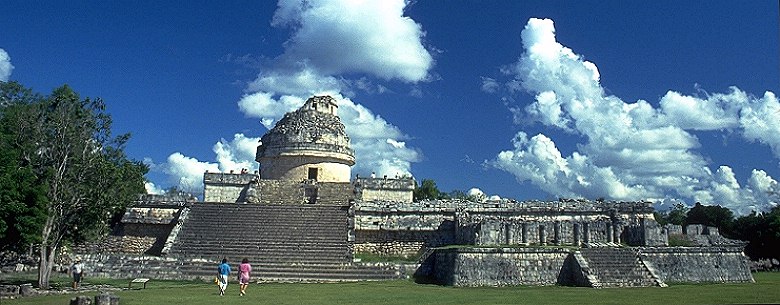 |
| Chichén Itzá, Yucatán |
 |
| Mexican flag: green for independence, white for purity and red for union |
 |
| Kukulkán Pyramid |
 |
| Sugar skulls for the Day of the Dead |
 |
| Offer Day of the Dead |


Comentarios
Publicar un comentario